The best way to store your dog's dry food is in its own sack, with the top tightly closed, placed inside a clean container with a lid, in a cool, dry place. It's what the FDA, the US food agency, recommends, and it's what works best with large sacks.
With a large dog, a 15 kg sack lasts nearly a month, so it spends weeks open. The table of how much dry food a large dog eats a day is in another post; here's how to make sure that dry food stays in good condition right to the last day.
Why does dry food spoil once it's opened?
Dry food spoils because of three things: heat, damp and air. According to the FDA, too much heat or moisture causes the nutrients in the food to break down.
- The fat goes rancid. Kibble contains fat, and with air and heat that fat ends up smelling rancid. The smell gives it away before the look does.
- Damp makes the food clump and brings mould. Mouldy dry food can't be salvaged: throw it all away, don't just remove the top layer.
- An open sack attracts mice and insects. This happens above all in garages, sheds and outbuildings.
Do you need to take the dry food out of the sack to store it?
There's no need, and it's better not to. The FDA recommends keeping dry food in its original sack because it carries the batch number, the manufacturer and the best-before date, which is the information you need if there's a problem with the product or a recall.
What works best is to fold the top of the sack down tightly, or close it with a clip, and put the whole sack inside a clean, dry container with a tight-fitting lid. The sack protects the food and the container keeps out air, damp and pests.
If you'd rather empty the sack into the container, at least keep the label with the batch number and date, or take a photo of it on your phone.
Where should you store dry food: in the house, in the garage or on the smallholding?
In a cool, dry, shaded place. The FDA sets the limit below 80 °F, about 27 °C, a temperature that can be exceeded in summer in garages and sheds.
| Where | What spoils it | How to store it |
|---|---|---|
| Pantry or interior room | Nothing in particular | It's the best place, if there's room |
| Garage or storeroom | Heat in summer, damp in winter | Container with a lid, off the floor and away from the wall |
| Shed or outbuilding | Damp, mice and insects | Sturdy sealed container, on a pallet or a shelf |
| In the sun, next to a boiler or under a metal roof | Heat | Better to find somewhere else |
Can you mix old dry food with new?
Better not. Finish one sack before starting the next, and don't tip the new food on top of what's left of the old: the old leftovers mix in with the new food and there's no longer any way of knowing which part is fine.
Between sacks, wash the container and dry it thoroughly. The FDA recommends this to remove the fat residue and crumbs that stick to the sides. A container left damp inside passes that moisture on to the new food from day one.
And the dry food inside the feeder?
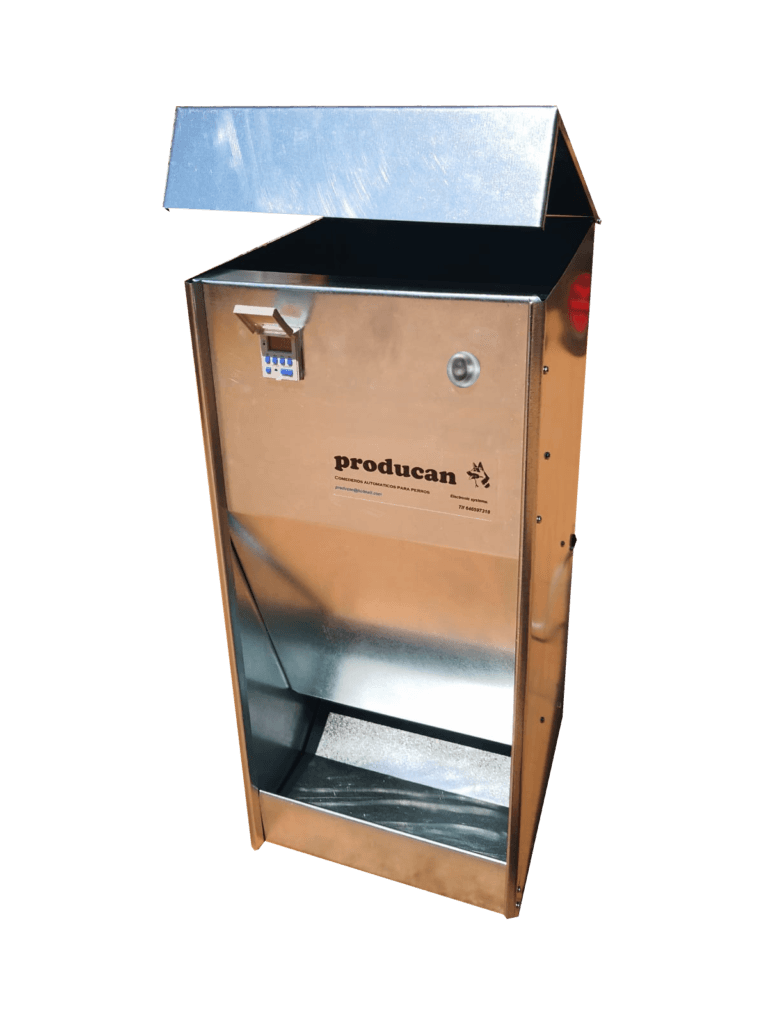
The food in the feeder needs the same as the food in the sack: to be kept sealed and dry. In an outdoor automatic feeder, the hopper acts as the container for the days or weeks it stays full.
A Producan automatic dog feeder is sealed, with the lid fitted over the hopper, and it's IP65 certified, so rain doesn't reach the dry food. What IP65 means and why the feeder can stay outdoors all year round is explained on its own page.
- Refill it when it's nearly empty. It's the same rule as with the sack: better not to add new food on top of food that's been in there for weeks.
- If your dog doesn't eat much, don't fill it to the top. The hopper's 40 L is around 15 kg of dry food; for a small dog that's food for a long time, and it's better not to leave it in there for months.
- Wipe the inside with a dry cloth now and then. Do it when it's nearly empty, and especially before winter.
The feeder in winter: rain, damp and dry food kept right explains where to put it so the outlet stays dry.
If the dry food is going to spend weeks away from the house, in a yard or on a smallholding, the Producan P1 is plugged into 220 V and the Producan P3 has a 12 V battery. Both have the same sealed galvanised steel hopper.