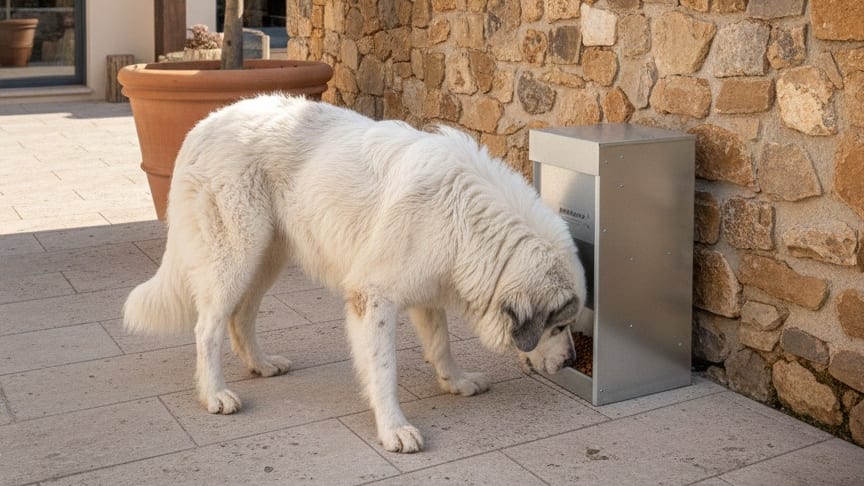
A large adult dog eats between about 300 and 600 grams of ordinary dry food a day: close to the lower figure if it weighs 30 kilos and isn't very active, and close to the higher one if it weighs 40 or 50 kilos and lives outdoors. The exact figure is on the feeding table on your dry food sack, but there's a sum that helps you get your bearings.
How much dry food does a dog eat a day, by weight?
This table is calculated using the energy formulas vets use for healthy adult dogs, and a dry food of between 3,500 and 4,000 kilocalories per kilo. The lower figure in each row is for a dog that isn't very active; the higher one, for an active dog that isn't neutered.
| Dog's weight | Dry food a day | 15 kg sacks a month |
|---|---|---|
| 20 kg | 230-340 g | 0,5-0,7 |
| 25 kg | 270-400 g | 0,5-0,8 |
| 30 kg | 300-460 g | 0,6-0,9 |
| 35 kg | 340-520 g | 0,7-1 |
| 40 kg | 380-570 g | 0,8-1,1 |
| 45 kg | 410-630 g | 0,8-1,2 |
| 50 kg | 450-680 g | 0,9-1,4 |
These are guide figures. If the table on your dry food sack says otherwise, go by the sack: each dry food has its own energy per kilo and its own serving.
Does the 2% of body weight rule work?
For large dogs, the rule that a dog eats 2% of its weight a day overshoots. By that rule, a 35-kilo German shepherd would have to eat 700 grams a day, and with most dry foods that means making it fat. We used it ourselves in the first version of this article, and we've corrected it.
The reason is that the energy a dog needs doesn't grow at the same rate as its weight: a 50-kilo dog doesn't eat twice as much as a 25-kilo one. In large dogs, the daily serving usually works out at between 1 and 1.5% of body weight.
How many sacks of dry food does a large dog get through a month?
An active dog of 30 to 40 kilos gets through nearly one 15-kilo sack of dry food a month. A dog of 20 to 25 kilos uses between half and three quarters of a sack, and an active 50-kilo dog goes over a sack and a quarter. With two dogs, double it.
A 70-kilo mastiff, to give you an idea, eats somewhere between about 600 and 900 grams a day, depending on how active it is and the dry food it eats.
What changes the amount of dry food a dog needs?
- The dry food. Dry foods range from about 2,800 to about 4,800 kilocalories per kilo, so with a more energy-dense food you need quite a lot less.
- Activity. A dog that roams the smallholding or works uses more energy than a dog that spends the day lying down.
- Neutering. A neutered dog usually needs a little less energy than an entire dog of the same weight.
- Age. A puppy eats more in proportion to its weight than an adult, and an older dog usually needs a little less.
How do I know if I'm giving it the right amount?
By looking at the dog more than at the scales. In a dog at the right weight, you can feel the ribs without having to press and, seen from above, there's a defined waist behind the ribs. If you can't find the ribs, it's getting too much food; if you can see them from a distance, it's not getting enough.
Once the amount is right, the number of feeds matters just as much. An adult dog usually eats in two feeds a day, and a puppy in three or four. In large, deep-chested breeds, splitting the serving into several small feeds instead of one large one is the veterinary recommendation for reducing the risk of bloat and stomach torsion.
How long does a full 15-kilo automatic feeder last?
A Producan automatic dog feeder has a 40 litre hopper, around 15 kilos of dry food, so it feeds a large dog eating half a kilo a day for nearly a month. How long it lasts for each size of dog is worked out on the automatic dog feeders for large dogs page.
Its timer allows up to 30 feeds a day, so the serving can be split however you need. And the kibble falls by its own weight, with a patented dispensing mechanism and no auger, so it doesn't jam even with the largest kibble.
If you're not sure about your situation, tell us: how many dogs, how much they weigh and where the feeder is going. With that we'll tell you which version suits you.